
Making Advice and Consent based decisions - a practical guide
by Tony Fifoot, ~3 mins reading time.
Just before we jump into the practical guide, there’s a couple of informative points. Types of decisions, and Decision Owners.
Types of decisions
Jeff Bezos describes two types of decisions:
Type 1 decisions are big, hard to reverse, and consequential - the "one-way doors" you need to walk through slowly and carefully because backing out is costly or impossible.
Type 2 decisions are reversible "two-way doors" - if it doesn't work out, you can change course relatively easily. His point is that most decisions are actually Type 2, but organisations tend to treat all of them with the heavy process suited to Type 1, slowing everything down unnecessarily.
Consensus tends to treat every decision like a Type 1 (one-way door), while Consent recognises that most decisions are Type 2 - safe to try, reversible, and better made quickly with a path to adjust if needed.
“As organizations get larger, there seems to be a tendency to use the heavy-weight Type 1 decision-making process on most decisions, including many Type 2 decisions. The end result of this is slowness, unthoughtful risk aversion, failure to experiment sufficiently, and consequently diminished invention.”
Decision Owner
The Decision Owner is the named person accountable for a specific decision: framing it, gathering input, and ultimately making the call. Anyone at any level can be a Decision Owner. It's not a title or a position in the hierarchy, it's a role assigned to someone close to the problem who has the right influence to see it through. They need the relevant context, experience, information and will be responsible for the outcome. When decisions are safe-to-try, reversible "Type 2" decisions, the pressure goes off making the perfect call, meaning more people, with less authority can become decision owners.
The Practical Guide: How to implement
Start by starting. Begin with yourself. Try Advice for a few of your own decisions, and you'll likely notice better outcomes and more confidence in the approach within a couple of weeks. From there, look for smaller group decisions where you can trial a Consent based proposal - low-stakes, easy to reverse, good for building familiarity. Some simple structure helps a lot here, which is why I've put together a guide below. It's based on a process similar to Holacracy's Integrative Decision-Making (IDM), distilled into five steps using the acronym PARSE.
Propose - Clearly explain the challenge/ opportunity and make a specific proposal. Start with "I propose we..."
Ask - Take turns asking questions to clarify your understanding of the proposal. Only the proposer responds.
React - Take turns reacting to the proposal, raising an objection only if proceeding would cause hard-to-reverse harm, not just an opinion.
Solve - Proposer works with anyone raising strong objections to find a “safe to try” approach. (not generally needed for Advice based decisions)
Execute - With no valid objections left, we all commit, record the decision and execute the proposal.
Over time, moving the default decision making option from Consensus to Consent helps to build a "Safe-to-try" mindset through your company, leading to both speed and innovation.
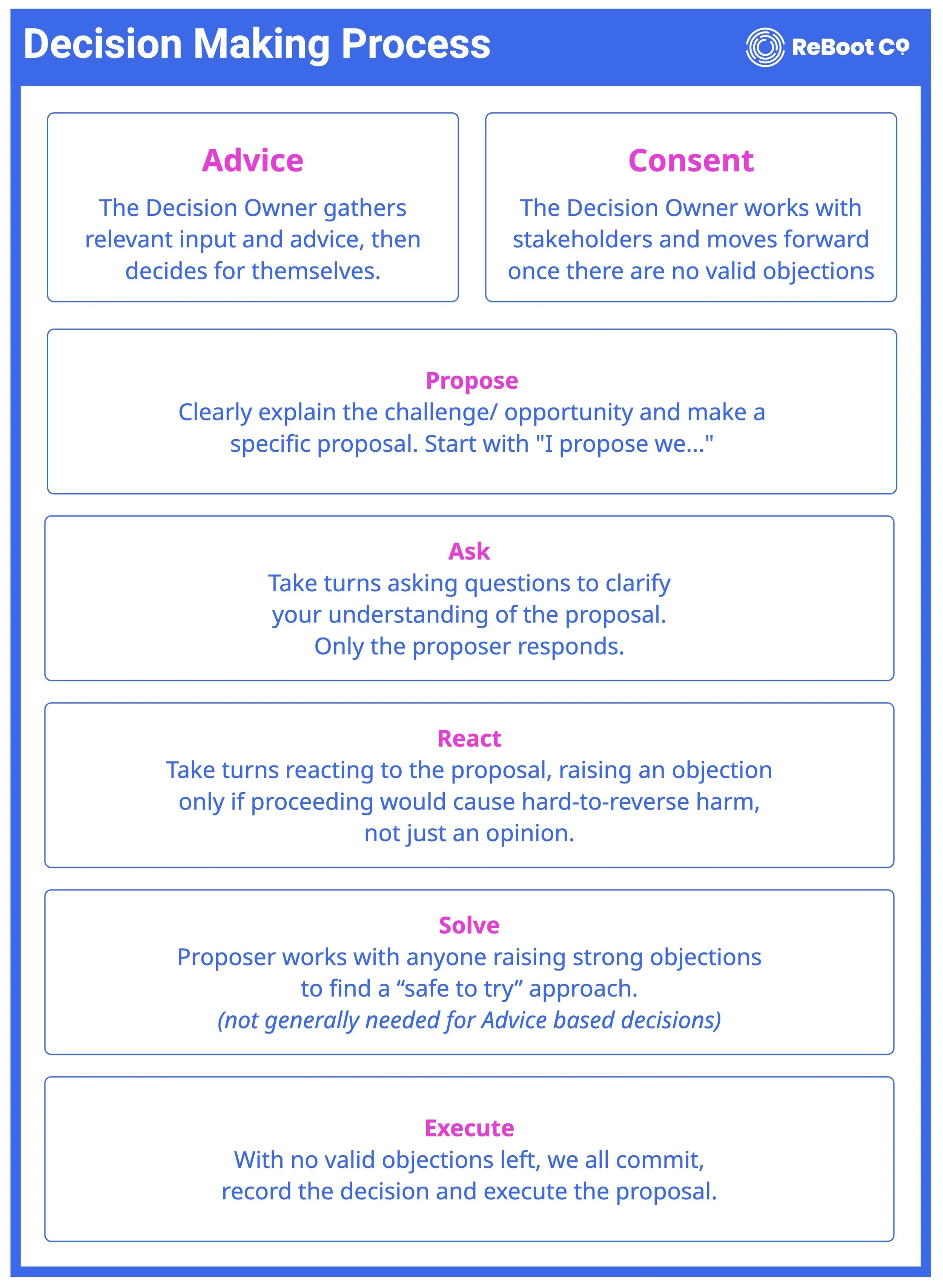
Overall, we want to move to high-quality, high-velocity decisions. Shifting to Advice and Consent based decision making provides a big step toward this.
Oh, and please reach out if you'd like a Proposal Framework Template to help you structure and define your proposals.
If you missed Parts 1–4 of this series, providing a lot of the why Advice and Consent are better approaches, the links are below.
1. Your decision making approach costs more than you think
2. The decision making spectrum. Why the extremes fail
3. Advice - Decisions designed for Speed
4. Making better tough decisions - from Consensus to Consent