
The decision making spectrum. Why the extremes fail
by Tony Fifoot, ~4 mins reading time
This is part 2 in a 4 part series, or maybe a 5 part series. Let’s decide a bit later.
In Part 1, I talked about why slow and broken decision making costs more than most people realise. Today I want to give you a map. It’s a way to see how decisions are actually made in most organisations, and why the default approaches cause so much of the dysfunction.
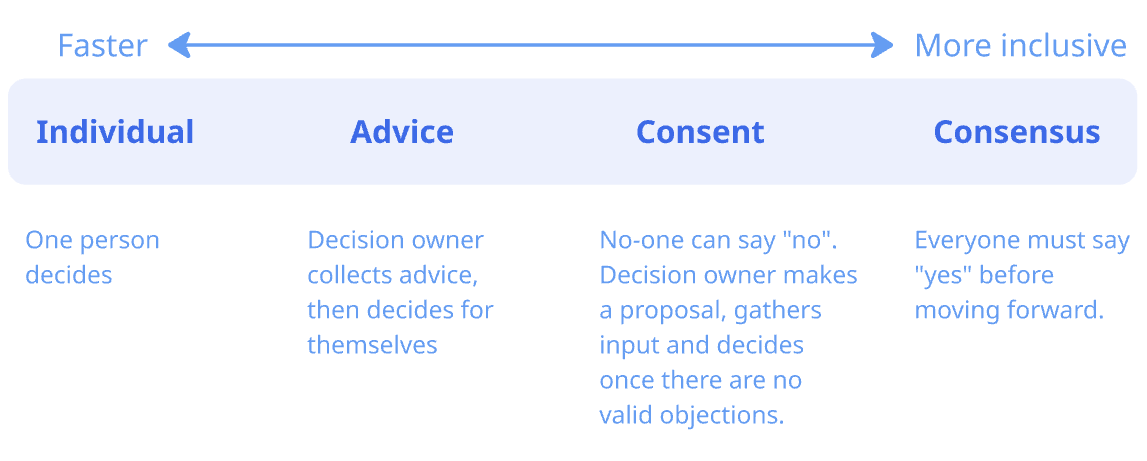
There are four main approaches when make a decision. Think of them as a spectrum, running from one extreme to the other. Note: This is oversimplified, but is a useful model for the purpose of this exercise.
At one end, Individual Action: one person decides, with little or no input from others. At the other end, Consensus: the whole group decides, and everyone has to agree before anything moves forward. In between those two extremes sit Advice and Consent, which I'll cover in detail in Parts 3 and 4.
None of these four approaches is wrong. Each has a context where it genuinely makes sense. The problem is that most organisations never consciously choose which one to use. Their inbuilt defaults tend to be the two extremes.
“Before making a call on your own, ask: should I seek advice first?
Before defaulting to consensus, ask: is it safe to try, or will this sink the ship?”
Individual Action
Individual Action is fast, which is why people use it, especially when a decision has been dragging and someone finally has enough and just calls it. There's also a well-meaning version: empowering someone to own a decision and move it forward. Side note: how often do you explicitly define decision rights upfront? I might need another post about that.
But Individual Action has a consistent problem. It typically concentrates the decision with whoever has the most authority, not necessarily whoever has the most relevant knowledge. The people closest to the work, the ones who understand the detail and the real-world implications get cut out leading to a poor decision. It feels faster, but the lack of input tends to create debate and friction later that slows down execution anyway.
It's not inclusive. When one person decides alone, you've effectively handed the keys to whoever holds the most structural or influential power. Other perspectives often aren’t considered at all.
Consensus
Consensus is the other default, and it usually comes from a good place. The intention is to make sure everyone has a voice, that all perspectives are heard, and that nobody feels steamrolled.
In practice though, consensus is slow, exhausting, frustrating, and (here's the surprising part) often less inclusive than it looks. In any group without a structured process, implicit power dynamics take over. People with more organisational authority speak up. People with less tend to self-silence, often out of a desire to keep things moving. The loudest or most senior voice ends up shaping the outcome, just more slowly and with more friction than Individual Action. Think what this does to motivation and engagement through the business.
Consensus also sets the default to 'no'. Nothing moves until everyone agrees. Any single outstanding concern, even a minor one that doesn't really affect the core decision, can stall the whole thing. That's where you get the perfection-over-progress trap: endless refinement, more analysis, more review cycles, while the window of opportunity quietly closes.
A common pattern
A common and damaging pattern I see isn't one extreme or the other, it's the swing between both. A team tries to reach consensus, gets stuck, and eventually escalates to the most senior person in the room, who makes the call unilaterally. You get the slowness of consensus and the quality problems of Individual Action, all in one decision.
Neither extreme is well suited to the kind of work most scaling organisations are doing: complex, fast-moving, with cross-functional interdependencies and a lot of people who have relevant context. Both extremes produce worse outcomes and weaker cultures than the approaches in the middle of the spectrum.
So what actually works?
Advice and Consent sit between the two extremes. They’re not a compromise, but are genuinely better approaches. They keep a named decision owner (so there's accountability and the decision actually gets made), while building in structured ways to include the right perspectives. They're faster than Consensus and produce better outcomes than Individual Action.
The shift isn't complicated, but it does require being intentional and some structure. To start, most teams just need to ask two questions more often: before someone makes a call alone, should they seek advice first? Before defaulting to consensus, is it safe to try or will we sink the ship?
Parts 3 and 4 of this series go into how both of those work in practice.
Tomorrow in Part 3: The Advice process: a simple, structured way to make faster, better decisions. Suitable for anyone making decisions, at any level.
If you missed the first part in this series, here is the link.