
If You're Not Doing a Value Stream Re-org, What Are You Actually Doing?
by Alex Stokes, ~5 mins reading time
Most technology transformations start in the right place. Leaders read the books, attend the conferences, talk about empowered teams and fast flow. And then they get to the hard part and stop just shy of the thing that actually changes outcomes.
They improve ways of working, introduce agile rituals, maybe adopt a framework or two. But they don't touch the structure.
And the structure is everything.
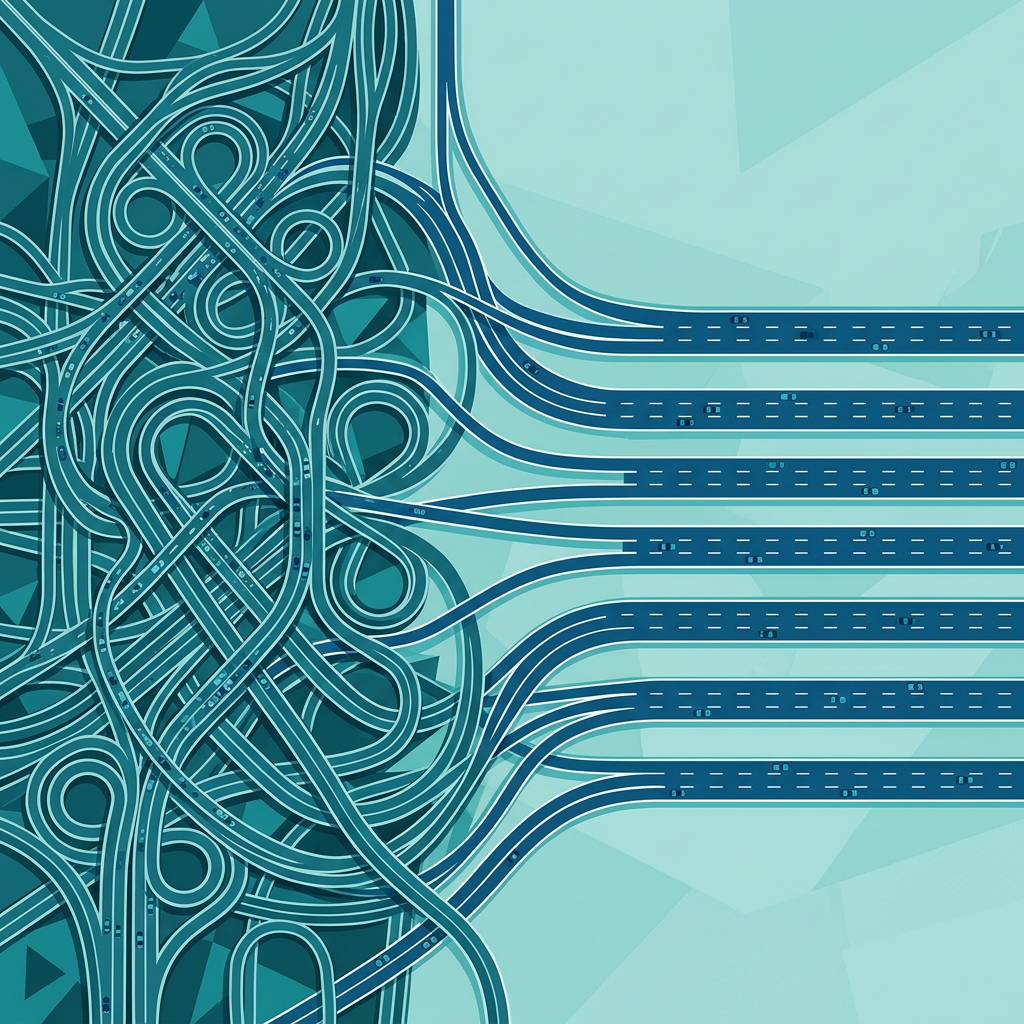
Over the past several years, the team at ReBoot Co. has guided five organisations through what we call a Value Stream Re-org: a deliberate restructuring of teams around the actual flow of value to customers, using a Team Topologies approach as guidance. The results have been significant. Each time, the thing that unlocked those results wasn't a new process. It was the reorganisation around the flow of value.
The Problem You're Probably Living With
When people are organised around legacy org charts rather than around the actual flow of value to customers, we see the same symptoms every time:
Teams drowning in requests from multiple directions
Dependencies that multiply faster than you can clear them
Large teams where nobody owns anything end-to-end
Cognitive overload that burns people out, even when they're brilliant
Delivery timelines that confound everyone, because the work itself doesn’t seem that hard
This isn't a people problem. It's a structural problem. And Conway's Law is quietly at work in the background. Your systems reflect how your teams are organised, whether you like it or not.
“Organizations which design systems are constrained to produce designs which are copies of the communication structures of those organizations.”
Your problems are not flaws in your people. They're structural. It's what happens when teams are asked to own too much, coordinate across too many boundaries, and serve too many stakeholders at once.
This was exactly the picture when I first embarked on these types of Value Stream Transformations in 2023. Large teams, tightly integrated platforms, work flowing in from too many sources, and poor prioritisation discipline. Leaders believing there was something wrong with their people. It's a common trait I see in senior leaders. Sometimes they sidle up to me and ask outright if they have the "right people," hoping that some magic hire will fix all their woes. Happy to say that in three decades this has never been the answer. I prefer to quote Fujio Cho, Toyota's former President and Chairman:
“We get brilliant results from average people managing brilliant processes, while our competitors get average or worse results from brilliant people managing broken processes.”
The problem is never the people. The problem is in the system. And if your system is organised around functional hierarchies instead of small, empowered, cross-functional teams, you will never win.
What a Value Stream Re-org Actually Involves
A Value Stream Re-org is not a shuffling around of reporting lines or boxes on an org chart. It's a deliberate redesign of how teams are shaped around the actual flow of value, using Team Topologies as the design framework, and Domain Driven Design principles to define sensible boundaries.
The big question we're trying to answer is: how does value actually flow to the customer, and what team structure best supports that flow?
We run this through four phases: Explore (go observe and understand what's actually happening), Co-Design (do this with the teams, not to them), Plan (account for all the human realities, budgets, headcount, the crunchy conversations), and Deliver (roll it out with proper enablement and change support).
One of the most important rules in the co-design phase is the "No Names" rule. We design for flow first. We define the domains, the team types, the interaction modes. Then, and only then, the people fit into the structure. The model has to work for generating value in its own right first. The moment you start designing around preferences or politics, you stop designing for flow.
This takes courage. Not every leader can set aside their positional power to engage in this activity for the good of the flow of value. It requires nuanced and experienced handling, and I don't believe it could be done easily from within the organisation. At least, our customers tell us that an external catalyst is extremely important.
What Happens When You Do It
At REA Group, we worked with a brilliant internal team, Nerine, Nicole, Alison and the broader leadership group, and we presented the results of our work at the LAST Conference in November last year. The full case study is live on the Team Topologies website if you want the detail.
But here's the summary version:
Flow efficiency doubled. As team sizes reduced, with real domain ownership and real decision-making authority the ability to serve a faster flow of value opened up. 94% team engagement score, which I've been told is basically unheard of globally. 40% reduction in support tickets year on year. 75+hours per person per quarter saved, just by removing PowerPoint status theatre and replacing it with live, self-serve dashboards. And broker engagement, the actual customer measure, went up 15%.
And this isn't a one-client story. We've now run variations of this pattern in five organisations, each in different domains with their own nuances. The specific numbers are different each time, however the patterns of success are repeatable.
The Harder Truths
None of this is easy, and it's worth being clear about that.
Structural change involves real people, real budgets, and real feelings. The conversations you have when you're redesigning teams can be challenging. People worry about their roles, their relationships, their relevance. Leaders have to be willing to make bold calls and to repeat the "why" over and over again, long past the point where it feels necessary.
Resistance is normal. Even when people intellectually agree that the current structure isn't working, the anxiety of change is real. The work of good change management isn't to eliminate that anxiety, but to meet it with clarity, communication, and genuine inclusion in the design process.
The other thing we've learned is that this is not a one-off program. Organisational design is an evolving practice. After the initial re-org, REA Group continues to regularly review domain boundaries, interaction modes, and team composition. The structure you land on today is the right structure for now, and that's exactly as it should be.
If You're Reading This
If the challenges described here feel familiar, the most important step is usually not to find a better process or a different framework. It's to ask whether your structure is actually set up to let the people inside it succeed.
Value Stream Re-org is not the only answer. But in five consecutive implementations, it has been the most powerful lever we've found for unlocking what teams are actually capable of when the structure supports them rather than working against them.
We're sharing more on this and involving more case studies. In the meantime, if you want to explore what this might look like for your organisation, we'd love to talk.
This blog was written by me, a human (with a little Claude as my writing partner). Alex Stokes is the Co-Founder of ReBoot Co., author ofEmpowered Agile Transformation: Beyond the Framework, and a Team Topologies Advocate. She has led Value Stream Re-orgs at multiple organisations across financial services, property technology, private health, and not-for-profit.
Read the full REA Group case study on the Team Topologies website →